Executive Summary
Streaming companies already collect valuable first-party signals across their own mobile apps, websites, connected-TV apps, subscriptions, and customer accounts. The measurement opportunity is to connect those signals so the business can understand one customer's activity across devices instead of treating every device as a separate user.
When implemented well, first-party identity can help a streaming company recognize that an existing mobile customer later activated a CTV app, reduce duplicate customer counts, connect engagement across owned surfaces, and build a more complete lifecycle view. It can turn fragmented device events into a more useful customer journey.
But first-party identity has a boundary. It is strongest inside environments the streaming company owns and where the customer can be connected through a permitted account or identity relationship. It does not automatically reveal every external media exposure or prove that marketing caused an outcome. The business value comes from knowing what first-party identity can connect, where the chain breaks, and what other measurement methods are needed beyond that point.
The business problem: the customer moves, but the data often does not
A customer may first interact with a streaming service on a phone, create an account, browse content, subscribe, and later install or open the service on a connected television. To the customer, that is one relationship with one streaming service. To separate analytics systems, it can look like several unrelated device events.
That fragmentation creates practical problems. The business may count the same customer more than once. A CTV activation may be classified as new acquisition even though the customer already existed on mobile. Marketing, product, and analytics teams may each see only part of the journey. Lifecycle reporting becomes harder because behavior is organized around devices instead of the customer relationship.
First-party identity gives the company a way to create continuity across the surfaces it controls.
What first-party identity gives a streaming company
First-party data includes the events and attributes a company collects through its direct customer relationship: app opens, content views, subscriptions, searches, purchases, preferences, and other interactions.
First-party identity is what allows selected events to be associated with a stable account, profile, entitlement, device relationship, or another permitted internal identifier. In practical terms, it provides an identity spine that can connect activity across owned environments.
The key is that the identity spine should not replace the underlying event data. Identity tells the company which records can be connected. Event instrumentation tells the company what actually happened.
A practical cross-device journey
Consider a customer who responds to marketing on a phone and enters the streaming service's owned environment. From that point forward, first-party identity can begin creating continuity if the customer authenticates and the required events are instrumented.
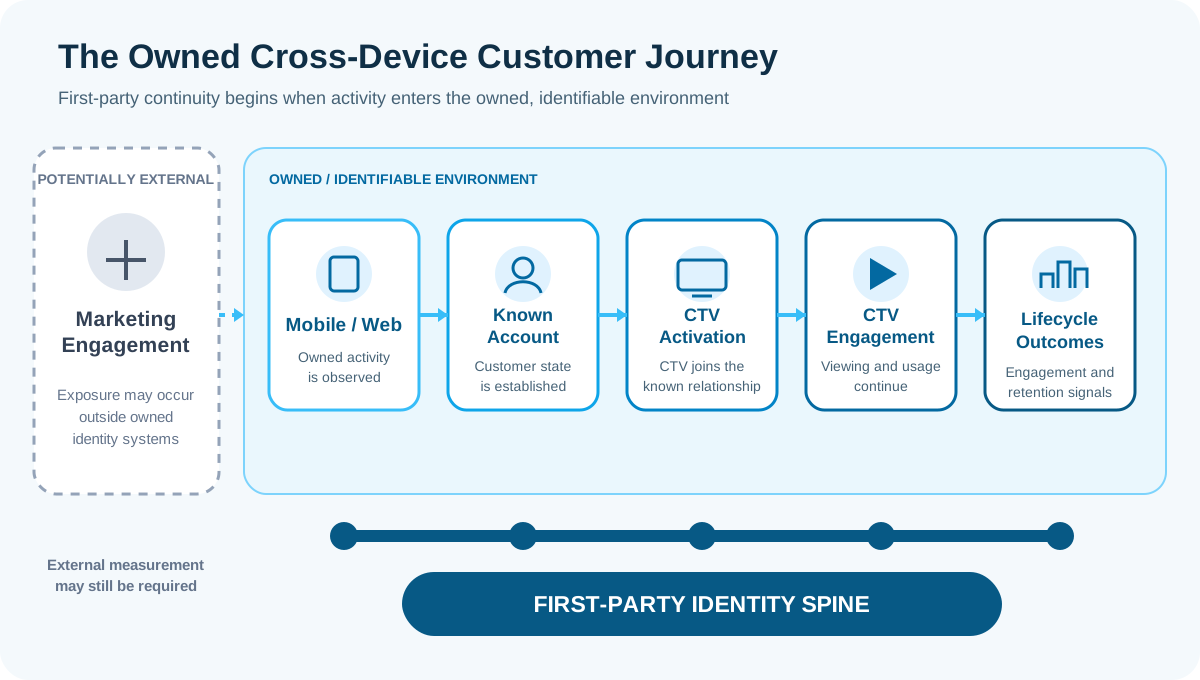
| Journey stage | What the company can observe | What first-party identity adds |
|---|---|---|
| Mobile or web engagement | Visit, app open, content browse, account creation, subscription, or other instrumented action. | Associates permitted activity with a known account or profile instead of only a device/session. |
| Known customer state | Subscription, entitlement, account status, preferences, prior activity. | Establishes that the customer relationship already exists. |
| CTV activation | CTV app open, authentication, profile selection, activation, device/app context. | Connects the CTV experience to the existing customer relationship when the identity link is available. |
| CTV engagement | Content starts, sessions, viewing activity, repeat usage, and other instrumented events. | Allows engagement to be analyzed as part of the same owned customer lifecycle rather than as an isolated CTV device. |
| Ongoing lifecycle | Reengagement, subscription changes, disconnect/churn signals, purchases, and other outcomes. | Supports a cross-device view of how the known customer relationship develops over time. |
This is the part of first-party identity that matters most operationally. The company can move from asking, “What did this device do?” to asking, “What happened across the owned relationship with this customer or account?”
Why activation and acquisition should not be confused
One of the clearest business benefits is better classification of growth.
Suppose an existing customer has already subscribed or created an account through mobile. Several days later, that customer authenticates on a Roku or another CTV app for the first time. If the systems are disconnected, the CTV event may look like a new user appearing organically on the television platform.
With first-party continuity, the business can recognize that the customer already existed and that the CTV event represents activation or device expansion rather than a completely new customer relationship.
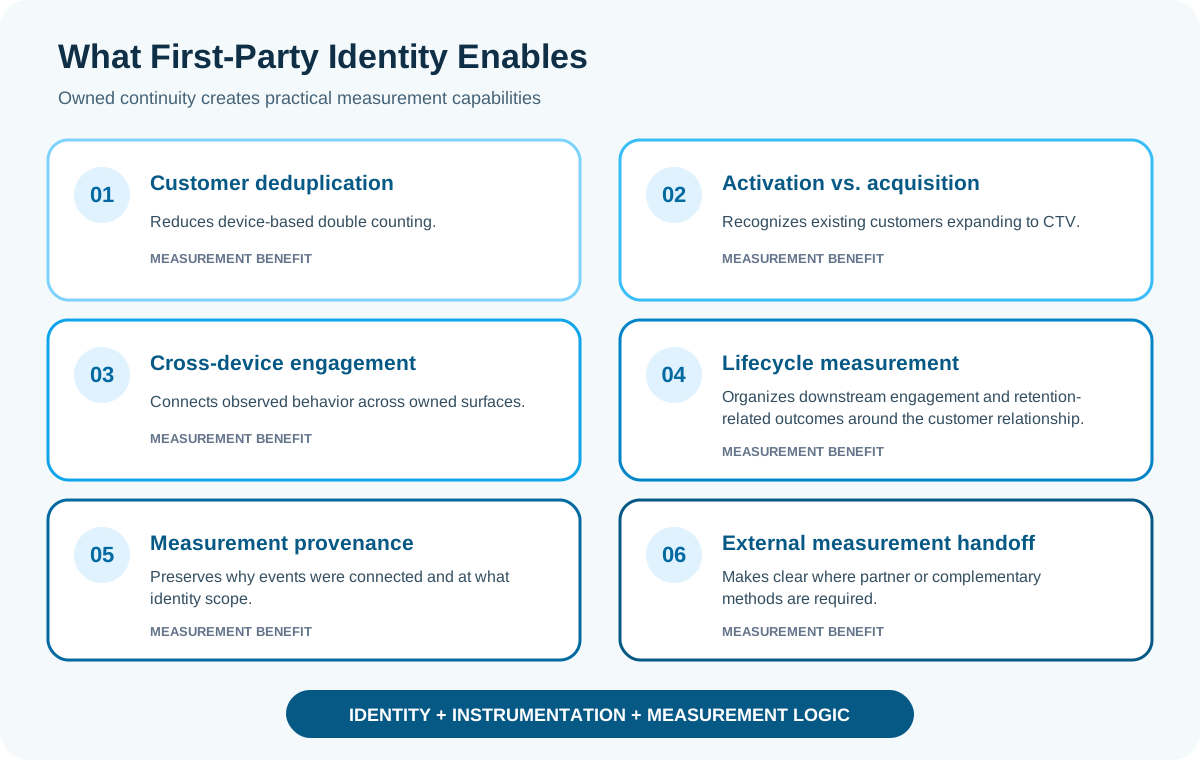
That distinction affects acquisition reporting, channel evaluation, customer counts, and how teams interpret CTV growth. It also creates a cleaner foundation for measuring what happens after activation.
First-party identity improves lifecycle measurement
Streaming growth does not end when a customer installs or opens another app. Once identity and event data are connected, teams can examine how the customer uses the service across owned devices over time.
For example, a company can study whether customers who activate CTV become more engaged, generate more viewing activity, use the service across more surfaces, or show different churn/disconnect behavior than customers who remain on one device. Those are lifecycle questions. First-party identity makes them easier to analyze because the customer relationship can persist while the device changes.
The identity layer does not create those outcomes or replace the metrics used to evaluate them. It gives the business a more coherent way to organize the behavior that has already been observed.
The measurement architecture behind the journey
A useful first-party measurement architecture does not need to begin with a massive identity graph. It can begin with a few disciplined building blocks.
1. A stable internal identity key
Use a stable internal account or customer identifier, distinct from raw personally identifiable information wherever possible, to organize the direct customer relationship.
2. Consistent event instrumentation
Mobile, web, and CTV surfaces need to emit the events the business actually wants to measure, along with relevant context such as timestamp, device/app instance, profile, subscription state, campaign context, and content activity.
3. Identity-resolution rules
Define which records are allowed to be connected and at what scope. The system should know whether a relationship comes from the same authenticated account, a profile, a device relationship, a household inference, a partner match, or a model.
4. Provenance
Preserve why two records were linked. Do not store only a generic conclusion that they belong to the 'same user.' This makes measurement auditable and keeps stronger and weaker evidence from being mixed together.
5. Measurement logic tied to the business question
Use the connected data to answer a defined question: acquisition, activation, reengagement, engagement, subscription, retention-related outcomes, or another business result.
Where the first-party chain breaks
The strongest first-party continuity usually exists inside authenticated, owned environments. The measurement problem changes when an important part of the journey happens somewhere the streaming company does not control.
For example, a streaming service may know that a customer used its mobile app and later authenticated on CTV. But if the marketing exposure happened on another publisher, platform, or walled garden, the streaming company's internal account ID does not automatically make that exposure visible.
That external exposure gap may require privacy-enhancing partner matching, platform-provided measurement, clean-room workflows, household or probabilistic methods, panels, experiments, or modeled approaches depending on the question and the data available.
The important architectural point is that these methods extend the first-party identity spine. They do not replace the value of having a strong internal customer identity foundation.
A short but important identity guardrail
An authenticated account is not always the same thing as an individual viewer, especially on a shared television. A deterministic account link can therefore be highly useful for connecting an owned customer journey without proving which person was physically watching every CTV event.
This distinction is covered in more depth in CTVBridge's companion article, “Household vs. Individual Identity in CTV.” For this discussion, the operational rule is enough: preserve the identity scope of the link and do not make a more specific claim than the evidence supports.
Identity, observation, and causality remain separate
First-party identity can connect a known customer journey. Event instrumentation can verify that a defined action occurred. Neither one, by itself, proves that marketing caused the action.
If a campaign is associated with a customer who later activates CTV, first-party identity can improve the evidence chain and reduce misclassification. If the business question is whether the campaign created incremental behavior that would not otherwise have happened, an appropriate causal method is still required.
This separation keeps first-party identity in its proper role: a measurement foundation, not a shortcut around attribution limits or incrementality.
What executives should build and measure
For streaming leaders, the strategic advantage is not simply 'owning an ID.' It is building a durable measurement asset that makes more customer journeys observable and less dependent on disconnected platform identifiers.
| Executive question | Why it matters |
|---|---|
| Can we recognize the same authenticated customer across our mobile, web, and CTV surfaces? | Establishes the basic owned cross-device identity spine. |
| Can we distinguish an existing customer's CTV activation from true new-customer acquisition? | Prevents device expansion from distorting acquisition reporting. |
| Are the same important events instrumented consistently across surfaces? | Identity without reliable events cannot explain behavior. |
| Can we follow engagement and lifecycle outcomes after a customer expands to CTV? | Turns identity continuity into useful business measurement. |
| Do we preserve why records were linked? | Keeps deterministic, household, partner, and modeled evidence auditable. |
| Where does our visibility end when the journey leaves our owned properties? | Identifies the point where partner or complementary measurement is needed. |
| How much of our customer base is anonymous or unauthenticated? | Prevents the known-user population from being treated as the entire audience. |
| Are identity uses aligned with permissions, platform policy, security, and purpose? | A direct customer relationship does not make every possible identity use appropriate. |
The executive takeaway
First-party identity matters because streaming customers do not live on one device. A strong internal identity spine can connect the parts of the journey a streaming company directly owns and turn fragmented device activity into a more useful customer view.
The most immediate business value is practical: better deduplication, clearer activation-versus-acquisition classification, stronger lifecycle measurement, and a better foundation for understanding cross-device behavior.
The boundary is equally important. First-party identity does not make every external exposure visible, does not eliminate shared-screen ambiguity, and does not prove causality. The strongest measurement architecture uses first-party identity as the owned foundation, then adds other methods only where the business question extends beyond that foundation.
References
- IAB Tech Lab — Identity Solutions Guidance (2024)
- IAB Tech Lab — Publisher Advertiser Identity Reconciliation (PAIR)
- IAB Tech Lab — Data Clean Rooms: Guidance and Recommended Practices
- Android Developers — Best practices for unique identifiers
- Android Developers — App Set ID guidance
- Media Rating Council — Cross-Media Audience Measurement Standards
- Nielsen — Co-viewing and TV audience measurement resources
- The Trade Desk — Identity graph educational resources
AI Transparency
CTVBridge uses AI tools to support research, content development, and editorial review. All articles are reviewed and approved by a human editor, and factual claims are supported by cited sources.