Executive Summary
CTV measurement often starts with a deceptively simple question: who saw the ad? On a connected television, the answer may be a device, a household, an authenticated account, a profile, or an individual person. Those identity levels are related, but they are not interchangeable.
The right goal is not to force every CTV event into the most granular identity possible. It is to use the identity level that matches the business question and the evidence available. Household identity can be exactly right for a shared screen or household-level decision. Individual identity becomes more important when the outcome belongs to a specific person or when a marketer wants to claim that the same consumer moved across devices.
For executives, the practical rule is simple: precision is not the same as certainty. Ask what entity was actually identified, what was observed versus inferred, and whether the reporting claim matches that evidence.
The TV May Be Known. The Viewer May Not Be.
Imagine an ad plays on the television in a family room. Later, someone in that household picks up a phone and takes an action. A measurement system may be able to associate the TV and phone with the same household. That is useful. But it does not automatically prove that the person who used the phone was the same person who saw the ad.
This is one of the structural differences between CTV and mobile. A phone is usually used by one person. A television is often shared. The screen can be identified more confidently than the viewer in front of it.
That difference affects reach, frequency, attribution, personalization, and cross-device measurement. The mistake is not using household identity. The mistake is making a person-level claim from household-level evidence.
Identity in CTV Is Layered
The word identity often compresses several different concepts. A more useful way to think about CTV is as a set of identity layers. These layers do not represent a ranking from bad to good. They represent different levels of evidence.
| Identity layer | What it tells you | Main limitation |
|---|---|---|
| Device | A television, streaming device, app instance, or advertising environment is known. | It does not tell you who was watching. |
| Household | Devices or identifiers are associated with the same home. | Several people can legitimately share the household. |
| Authenticated account | A known service or platform account is signed in. | The account itself can be shared. |
| Profile | A profile inside an account is selected. | Profiles can be shared or selected by the wrong person. |
| Individual | Evidence resolves activity to a person-level identity. | The claim requires sufficiently strong signals, methodology, and governance. |
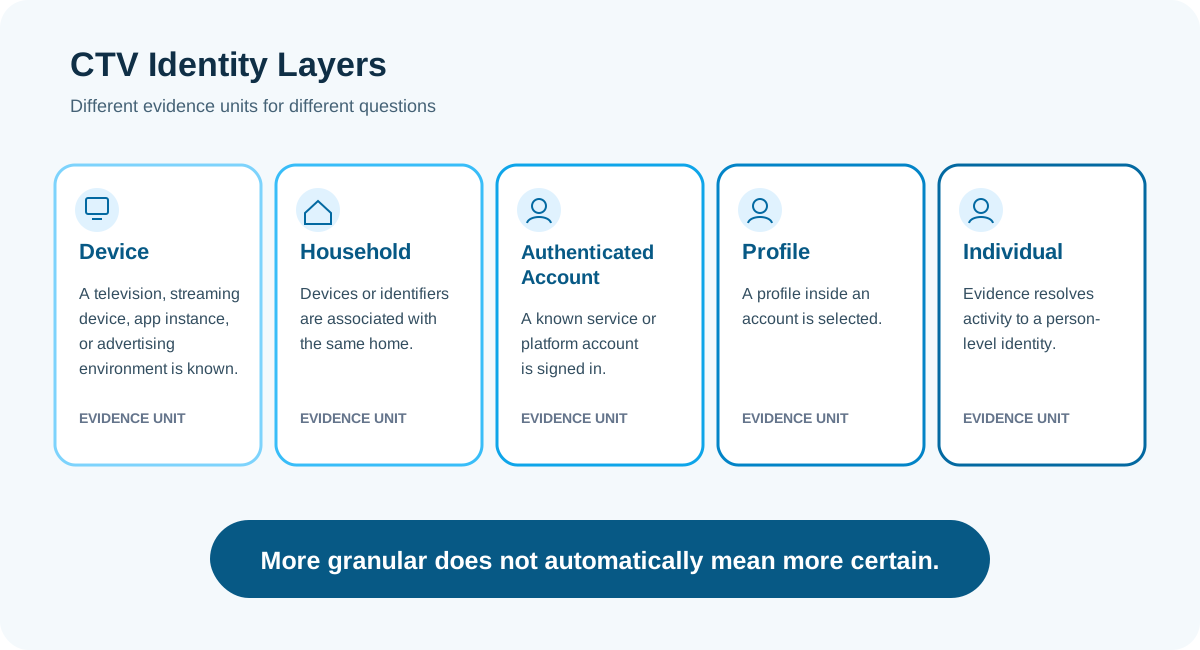
Authentication can strengthen the evidence without eliminating ambiguity. A streaming service may know the subscriber account with high confidence while still not knowing which household member is watching a particular impression.
Household and Individual Identity Answer Different Questions
Household identity is not simply a weaker version of individual identity. Television is a shared environment, and many business questions are genuinely household-oriented. Broad household reach, household frequency, entertainment subscriptions, and other shared decisions can be evaluated meaningfully at that level.
Individual identity matters more when the question belongs to one person. Examples include a person-specific subscription conversion, demographic delivery, cross-device retargeting, or a journey in which a marketer wants to know whether the same consumer engaged on mobile and later activated on CTV.
Greater granularity does not automatically mean greater truth. A person-level label based on weak inference can create more confidence than the evidence deserves. The better standard is fit-for-purpose identity: use the most specific level the business question requires and the evidence supports.
The Shared-Screen Problem
Co-viewing makes CTV different from many personal-device environments. One television impression may represent one viewer, several viewers, or no confirmed viewer at all. Device counts therefore should not silently become people counts.
The same issue appears in the opposite direction. If a household is associated with an exposure, reporting should not imply that every person in the household saw it. Knowing the household narrows the context. It does not establish audience presence for a specific person.
Where Measurement Claims Can Break
Reach
Device reach, household reach, and person reach are different metrics. Several CTV devices can belong to one household, and several people can belong to that household. Reporting should identify the unit being counted.
Frequency
Four household impressions could mean one person saw all four, two people saw two each, or several people saw one. Household frequency remains useful, but it should not be presented as person-level frequency.
Attribution
If a household receives a CTV exposure and someone in that household later converts, the measurement may support a household-level association. It does not automatically support the stronger claim that the exposed viewer was the person who converted.
Cross-device continuity
The distinction becomes especially important when the journey moves from television to phone, or from phone to television. A household association can show that two devices belong in the same environment. If the business question is whether the same consumer crossed devices, stronger person-level or deterministic handoff evidence is preferable.
How Identity Systems Bridge the Gap
Identity systems connect fragmented identifiers across devices and environments. They may preserve device, household, account, and person relationships rather than collapsing everything into one universal identity.
Deterministic relationships are established through directly known signals such as an authenticated account or another persistent relationship. Probabilistic systems infer relationships from patterns and can expand coverage, but they also introduce uncertainty. Importantly, deterministic does not mean individual. A deterministic relationship can identify a household or shared account just as confidently as it can identify a person.
The useful question is therefore not simply whether a match is deterministic or probabilistic. It is also: what entity does the match represent?
A Fit-for-Purpose Identity Framework
| Business question | Useful identity level | What can reasonably be claimed |
|---|---|---|
| Broad CTV reach | Household often sufficient | How many households were reached, if methodology supports it. |
| Household frequency | Household | How often the household was exposed, not how often each person saw the ad. |
| Person-specific subscription conversion | Individual preferred | A person-level conversion relationship when evidence supports it. |
| CTV app open after mobile engagement | Individual or deterministic cross-device relationship preferred | Same-consumer continuity only when the linkage supports that claim. |
| Demographic reach | Individual preferred | Person-level audience delivery when methodology supports it. |
| Cross-device retargeting | Individual preferred when possible | A better basis for reaching the person whose behavior triggered the audience. |
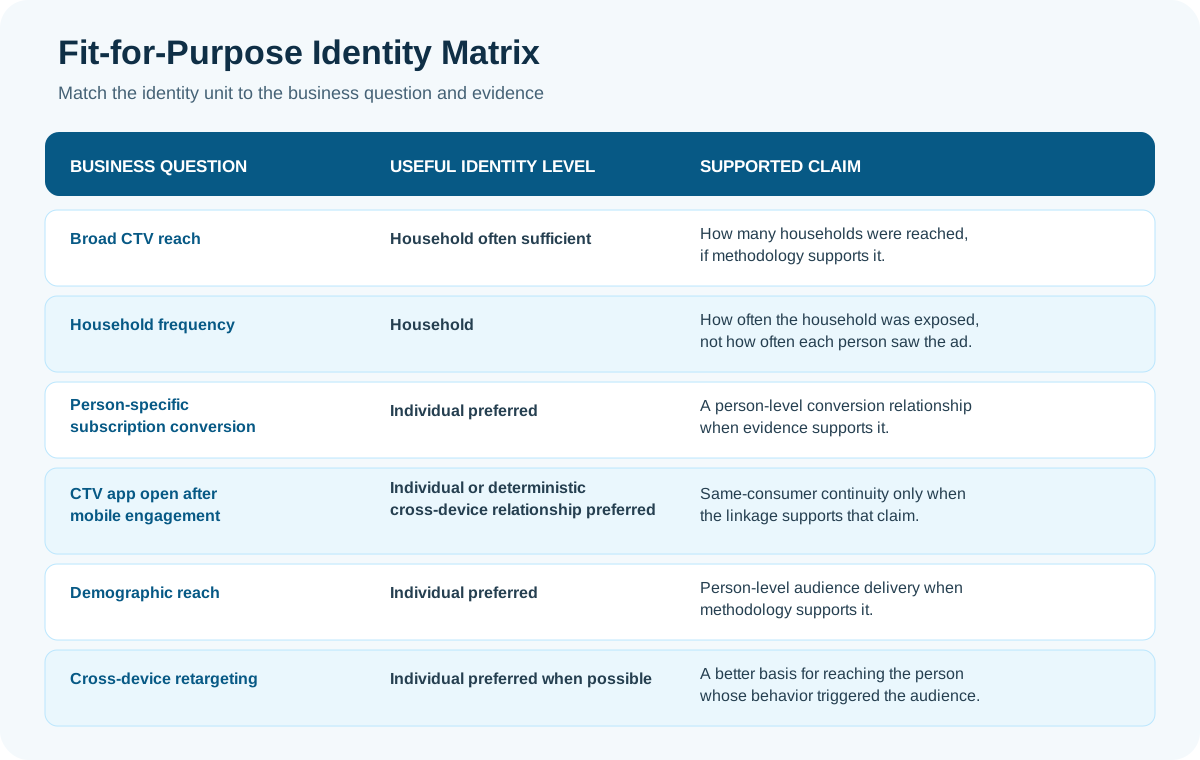
The framework is intentionally practical. The goal is not to maximize identity resolution. The goal is to avoid claiming more than the evidence can support.
Privacy and Governance Still Matter
Moving from a household relationship toward a person-level cross-device profile creates more powerful targeting and measurement, but it also increases the amount and sensitivity of linked data. Teams should understand which signals are used, which relationships are observed or inferred, how shared devices are handled, how consumer choices are respected, and how long identity relationships persist.
This is not only a compliance question. It is also a measurement-quality question. A system that cannot explain its identity unit, confidence, and methodology makes it harder for marketers to interpret the results correctly.
Questions Executives Should Ask
- What is the identity unit in this report: device, household, account, profile, person, or a combination?
- Which relationships are directly observed and which are inferred or modeled?
- How are shared televisions and shared accounts handled?
- What unit is used for reach and frequency?
- What unit is used for attribution and conversion matching?
- Does a deterministic match represent a person, a household, an account, or something else?
- Can reporting distinguish household association from same-person cross-device continuity?
- How is match confidence evaluated, and is match rate being confused with match quality?
- How are privacy choices, opt-outs, and data governance handled?
The Executive Takeaway
CTV identity is not a household-versus-individual contest. It is a question of matching the identity unit to the business question and the evidence.
Household identity can be the correct level for a shared screen and a household-level outcome. Individual identity becomes more important when the marketer needs to understand a person-specific journey or make a same-consumer cross-device claim.
The strongest measurement systems preserve those distinctions instead of hiding them. In CTV, the most granular identity label is not automatically the most trustworthy one. Use the most specific identity the evidence actually supports.
References
- IAB Tech Lab — Identity Solutions Guidance (2024)
- Media Rating Council — Cross-Media Audience Measurement Standards (Phase I Video), Final
- Nielsen — Need to Know: What is co-viewing, and why should you care? (2024)
- The Trade Desk — How identity graphs are built — present and future
- LiveRamp — RampID Mapping Files (updated 2025)
- LiveRamp — Identity and Identifier Terms and Concepts (updated 2026)
- Nielsen — Nielsen begins updated era of TV ratings with Big Data + Panel (2025)
- Nielsen — What sports can teach us about co-viewing on TV (2025)
- Nielsen — Need to Know: How are TV audiences measured? (2023)
- IAB Tech Lab — CTV Programmatic Guide
- Federal Trade Commission — Cross-Device Tracking: An FTC Workshop (2015)
- IAB Tech Lab — Privacy, Data, and Identity for CTV Advertising
AI Transparency
CTVBridge uses AI tools to support research, content development, and editorial review. All articles are reviewed and approved by a human editor, and factual claims are supported by cited sources.