Executive Summary
Connected TV (CTV) app opens are often reported as organic not because marketing had no influence, but because the measurement system cannot connect an earlier marketing interaction to the later TV app open. The customer may move from social, email, web, a QR code, or a mobile app to a television, hours or days later. When no eligible source survives that journey, the CTV open can fall into the organic bucket.
That does not mean the attribution platform is necessarily wrong. It means the label is often under-explained. For streaming leaders, the practical question is not whether every organic open should be reassigned to marketing. It is whether the organization understands what its organic bucket contains, where the attribution chain breaks, and which business decisions require stronger evidence.
A terminology note: many measurement platforms and industry conversations use “install attribution” as shorthand even when measurement is triggered when the app first launches. CTVBridge treats install and first open as separate outcomes. This article focuses on the measurable CTV app-open event; for the distinction between the two, see “Why Verified CTV App Opens Matter More Than CTV App Installs.”
The business problem: one customer journey, several measurement systems
A viewer can discover a streaming service on a phone, evaluate it on the web, and later decide that the experience belongs on the biggest screen in the house. They search for the app on Roku, Fire TV, Apple TV, Google TV, Samsung, LG, or another CTV platform, install it, and open it. To the customer, that is one continuous journey. To analytics systems, it may look like several unrelated events.
The mobile system may know that a paid social ad generated a click. The website may know that the visitor viewed a show page. The television may know that the app was installed and opened. But unless a usable bridge connects those events, the CTV open may have no eligible marketing source.
What “organic” actually means
The word organic carries two meanings that are easy to confuse. Marketing teams often use organic to describe unpaid discovery such as app-store search, editorial coverage, social sharing, public relations, or word of mouth. Attribution systems can also use organic as a fallback classification when an install or engagement is not attributed to a media source.
AppsFlyer, for example, defines organic installs as installs that are not attributed to a media source and notes that a click and app launch may fail to match because data is unavailable or another attribution condition is not satisfied. That distinction matters because an unattributed event is not automatically an uninfluenced event.
There is another business distinction worth making. Owned marketing is sometimes grouped into “organic” because there is no direct media spend. But email, push notifications, QR codes, website placements, and organic social still require technology, people, creative resources, and execution. If those activities influence CTV behavior but the resulting app open is simply labeled organic, the company loses visibility into which efforts are working. Understanding that contribution helps teams optimize the broader marketing investment, not only paid media.
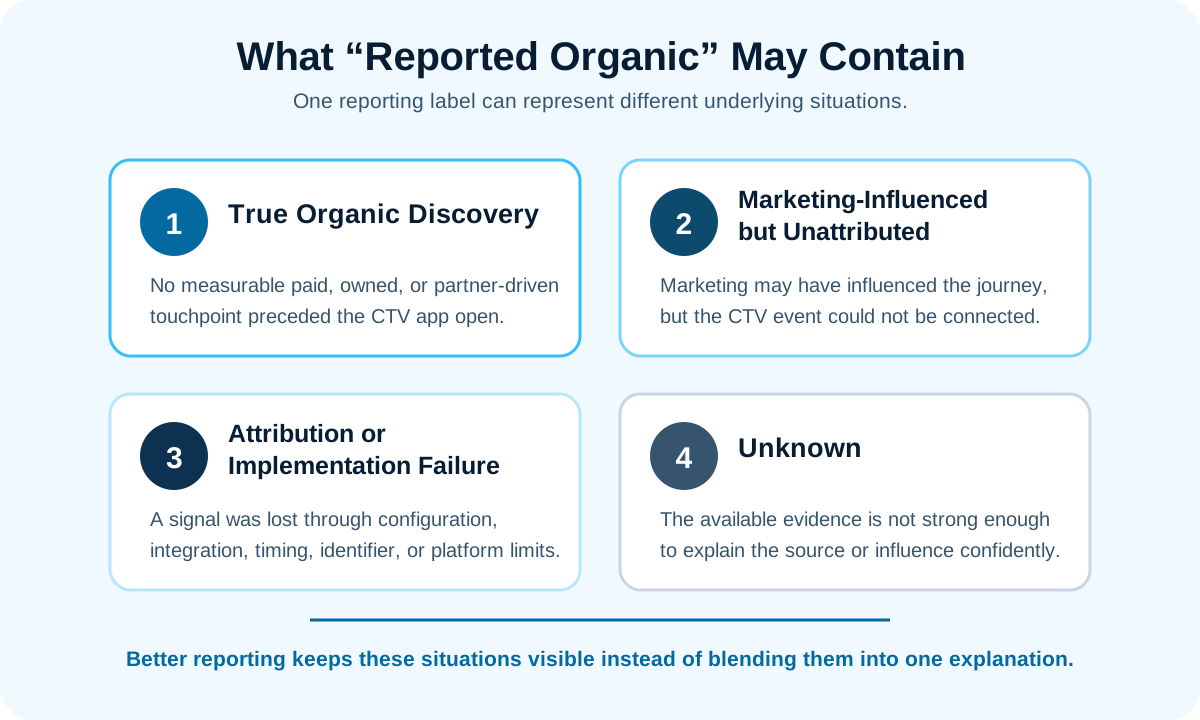
| What may be inside reported organic | What it means |
|---|---|
| Truly organic discovery | The viewer found the CTV app without a measurable paid, owned, or partner-driven touchpoint. |
| Marketing-influenced but unattributed | Marketing may have influenced the journey, but the CTV open could not be connected to that activity. |
| Attribution or implementation failure | A signal that should have been measurable was lost because of configuration, integration, timing, identifier, or platform limitations. |
Why attribution breaks
CTV attribution becomes difficult when the path between influence and outcome crosses devices, app stores, identities, and time. The following journeys show how the break can happen in practice.
Journey 1: Paid social to a manual Roku search
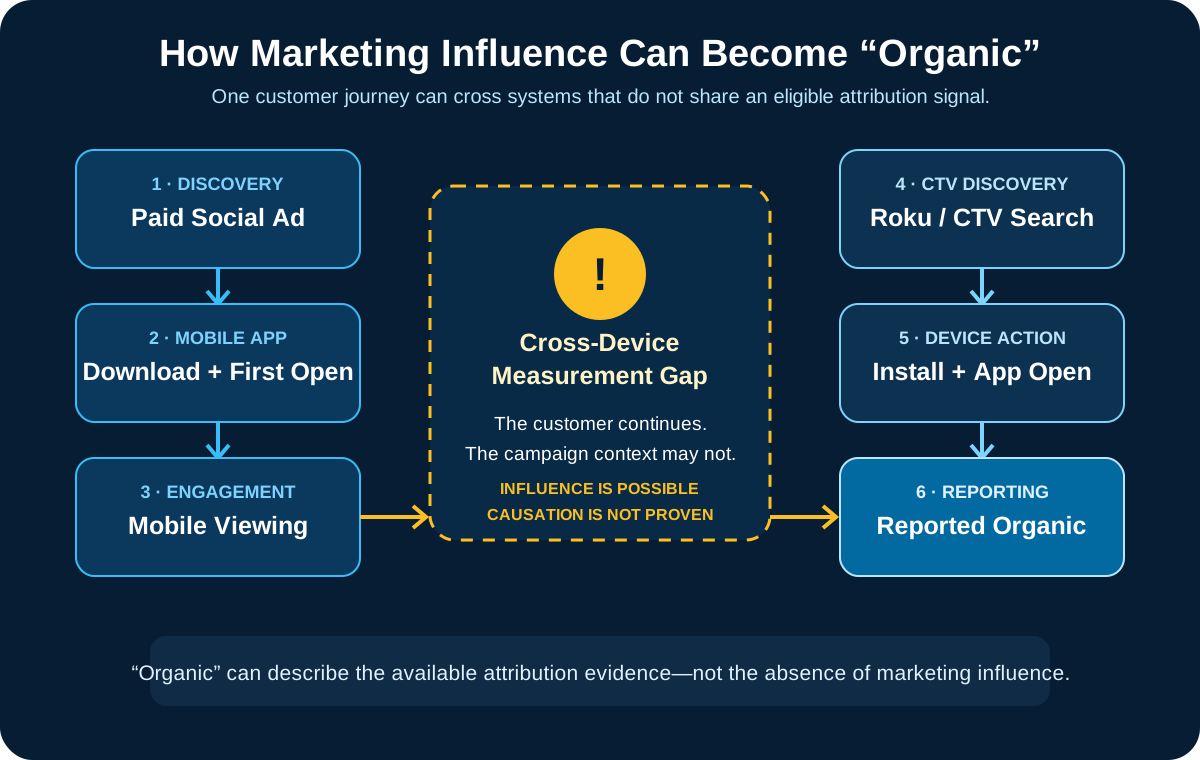
A viewer sees a clip from a new series in a social feed during the morning. They tap the ad, download the streaming service’s mobile app, open it, and begin watching content on their phone. Over the next few days, the viewer becomes engaged with the service and then decides they want to watch on the biggest screen in the house. They search for the service by name in the Roku store, install the CTV app, and open it.
The social platform can record the impression and click, while the mobile app can record the download, first open, and viewing activity. Roku can record the store search, install, and app activity. But if there is no supported cross-device link between the phone interaction and the Roku event, the original campaign context can stop on the phone. The CTV first open may therefore appear organic even though paid social helped bring the viewer into the streaming ecosystem and the viewer was already engaging on mobile.
Why that device expansion matters: public streaming data shows that big-screen viewing can represent substantially deeper engagement than smartphone viewing. In NPAW’s H1 2023 industry data, big screens captured 61% of all VoD minutes streamed. Smart TV users averaged 95 minutes of VoD playtime per day, while set-top-box and console users exceeded 120 minutes; smartphones recorded the fewest daily minutes among the device categories. For linear streaming, set-top boxes averaged 91 minutes per user per day compared with 20 minutes on smartphones.
More recent CTV data points in the same direction. Wurl’s 2024 CTV Trends Report found average CTV session length up nearly 7% year over year and daily hours of viewing up about 5%. Wurl notes that longer sessions create more opportunities for ad impressions and can increase advertising revenue potential. The implication is not that every CTV viewer is more valuable than every mobile viewer, but that understanding what drives a customer from mobile into sustained CTV viewing can matter for engagement and monetization decisions.
Journey 2: Email creates demand, but the TV completes the action
An existing subscriber receives an email about a live event on their phone. They tap the message, review the event details on the phone, and decide they want to watch it on television. Later they install the Fire TV app and sign in. The email interaction may be fully measured on mobile, yet if it does not preserve a connected path to the CTV installation and first open, the later TV event can arrive without the original source.
This creates a reporting problem. Email may be evaluated only on web traffic even though it also helped expand usage onto the television. The business outcome is not a new customer acquisition; it is device expansion and potentially deeper engagement from an existing customer.
Journey 3: The attribution window expires before the TV open
A viewer engages with a campaign, but does not install and open the CTV app until ten days later. If the applicable attribution window is seven days, the marketing touchpoint is no longer eligible for credit. The resulting organic classification can be correct under the configured rules while still being incomplete as a description of influence.
Other common breakpoints
- The CTV app store does not receive the original mobile or web campaign context.
- The app is installed on one day but not opened until later, and attribution or analytics only becomes active at first open.
- The marketing influence was an impression, public relations mention, creator post, or other exposure without a trackable click.
- Owned channels such as email, push notifications, websites, account pages, or QR codes are measured on one device but not connected to the later television event.
- A household-level signal connects devices but cannot prove which person saw the marketing or opened the app.
- Authentication happens after the CTV open, leaving the earlier device events anonymous.
- Privacy protections limit cross-company or cross-app identifiers.
- CTV platform capabilities differ by operating system, app-store flow, partner integration, SDK support, and reporting rules.
When CTV attribution does work
CTV attribution is not impossible. It can work very well when the measurement path preserves a supported signal or when the business controls a strong first-party identity bridge.
Example: authenticated cross-device identity
A logged-in subscriber receives a campaign on a phone, engages while authenticated, and later signs into the same account on the CTV app. The streaming company can use its first-party account identity to connect the events with high confidence. The linkage is strong because the same known account appears on both sides of the device transition.
That still does not prove the campaign caused the CTV open. It proves the events belong to the same account. Attribution rules decide which eligible touchpoint receives credit, while incrementality testing answers the separate causal question.
Example: supported platform attribution
Attribution can also succeed when exposure and conversion stay inside an integrated platform or a supported measurement flow. Current AppsFlyer documentation, for example, describes CTV, PC, and console attribution methods that include direct attribution links, self-reporting networks, cross-platform links, and landing-page flows. Some paths support deterministic matching when a supported identifier is available; others use probabilistic modeling.
The lesson is not that one platform solves every journey. It is that attribution quality depends on the exact path, the signals available, and the integrations in place.
Install, first open, and business value are different outcomes
Streaming teams should avoid treating an app install and an app open as interchangeable. An install shows that the app reached a device. A first open shows that the app launched. From there, sign-in, first stream, repeat usage, watch time, subscription behavior, churn or disconnect rates, LTV, and ROAS describe progressively deeper business outcomes.
This distinction is especially important when an app is installed remotely, restored automatically, preinstalled, or installed by one household member and opened by another. Measurement should name the exact event being evaluated rather than using “acquisition” as a catch-all.
A practical framework for evaluating organic CTV growth
1. Define the business outcome
Decide exactly what you are measuring: install, first open, account activation, first stream, subscription, device expansion, returning session, or revenue. Executives should not compare channel performance until the outcome is consistent.
2. Map the customer journeys
Document how people can move from CTV ads, mobile ads, web, email, QR codes, push notifications, platform search, and existing accounts to the television. This reveals where measurement is likely to lose continuity.
3. Inventory the available signals
Identify which steps carry click IDs, campaign parameters, account IDs, referrers, platform signals, timestamps, household signals, or first-party identifiers. This shows where deterministic evidence exists and where inference begins.
4. Label match confidence
Separate authenticated or platform-verified connections from household, probabilistic, modeled, unmatched, and implementation-failure categories. Do not blend different evidence levels into one number without explanation.
5. Audit attribution windows
Compare configured windows with the actual delay between marketing engagement and CTV behavior. A window should protect against unlimited credit while still reflecting realistic consideration cycles.
6. Separate acquisition from device expansion
An existing mobile subscriber adding a television is not a new customer. Reporting should distinguish new customer acquisition from expansion to another device, re-engagement, and activation.
7. Reconcile platform and internal data
Compare CTV platform installs, app first opens, MMP attribution, internal sessions, account logins, subscriptions, and media-platform conversions. Large gaps are diagnostic signals, not merely reporting noise.
8. Validate assumptions with experiments
Use holdouts, lift studies, campaign pauses, geo tests, authenticated cohorts, or other incrementality methods when the business question is causal. Attribution explains credit under a model; experiments help determine what changed because of marketing.
How executives should use this information
The goal is not to eliminate the organic bucket or force every CTV open into a marketing source. Doing so would replace one measurement problem with another. The goal is to understand the evidence behind the classification.
For budget allocation, leaders should be cautious about reducing investment simply because paid channels appear to have high CAC while organic CTV growth appears unusually strong. First ask whether paid or owned marketing is creating demand that the CTV measurement stack cannot connect. For campaign optimization, compare channels using outcomes and attribution methods that are genuinely comparable. For executive reporting, show where results are directly observed, inferred, modeled, or unknown instead of presenting every conversion with the same level of certainty.
The broader lesson
Customers do not experience separate mobile and television funnels. Measurement systems create those boundaries. As streaming journeys become more cross-device, organizations need to understand where those boundaries affect reporting.
Some CTV app opens are genuinely organic. Some are influenced by marketing that cannot be connected to the television. Some reflect implementation or integration gaps. Better measurement does not mean assigning credit to every possible touchpoint. It means making those categories visible enough that teams can make better decisions.
References
- AppsFlyer. About organic and non-organic installs.
- AppsFlyer. CTV, PC, and console platform attribution concepts.
- AppsFlyer. Roku integration with AppsFlyer.
- IAB. Implementing Cross-Channel Measurement for Marketers Playbook.
- Apple Developer. User privacy and data use.
- Roku Developer. Deep linking.
- Android Developers. Google Play Install Referrer.
- Branch. Attribution explained.
- NPAW. Why Big Screens Continue to Expand Their Dominance in Streaming (H1 2023 Video Streaming Industry Report excerpt).
- Wurl. The CTV Trends Report 2024.
AI Transparency
CTVBridge uses AI tools to support research, content development, and editorial review. All articles are reviewed and approved by a human editor, and factual claims are supported by cited sources.