The same conversion can tell two different stories
A streaming campaign can receive credit for a subscription without necessarily creating that subscription. That distinction sounds small, but it can change how a company evaluates channels, allocates budget, and decides what to scale.
Attribution asks which marketing touchpoints should receive credit for an observed outcome. Incrementality asks a different question: did the marketing activity create additional outcomes that would not have happened otherwise?
Neither question is enough on its own. Streaming companies need attribution to understand customer journeys and operate campaigns every day. They need incrementality to test whether the marketing investment is actually changing behavior. Better visibility into a journey is not the same as proof of causation, but that visibility remains essential: without a reliable view of how customers move across devices, teams have a weaker foundation for daily optimization, source classification, and downstream measurement.
Why the distinction matters more in streaming
Streaming journeys are unusually fragmented. An exposure may happen on a television while discovery, installation, registration, payment, or re-engagement happens on a phone, a web browser, an app store, or another television. The viewer, account holder, app installer, and payer may not even be the same person.
CTV also lacks the clean click path marketers are used to on mobile and web. App stores can interrupt referral context. Content launches, sports rights, promotions, seasonality, brand demand, and word of mouth can all increase conversion at the same time as paid media.
That creates a business risk: a channel can look efficient because it appears close to conversion while creating little new demand. The opposite can also happen. Video or CTV may influence the customer earlier, but another channel receives the final credit because the customer completes the journey somewhere else.
What attribution actually measures
Attribution is the process of assigning credit for a conversion or downstream event to one or more marketing touchpoints. Depending on the system, that can include first-touch, last-touch, multi-touch, view-through, data-driven, or cross-device attribution.
Its strength is operational visibility. Attribution can help teams answer questions such as:
- Which channels, campaigns, creatives, or placements appear in conversion paths?
- What acquisition source is associated with a subscriber, app open, or downstream event?
- How do CAC, ROAS, LTV, or payback compare under a consistent methodology?
- Where is the customer journey breaking across mobile, web, app stores, and CTV?
- Which campaigns should be adjusted today based on the signals available?
When identity and instrumentation are strong, deterministic cross-device attribution can materially improve the evidence chain. For example, it may connect a mobile marketing interaction to a later CTV app open that would otherwise have been classified as organic. In fragmented streaming journeys, closing that measurement gap can materially improve how teams understand channel performance and allocate budget.
But stronger observation does not automatically establish causation. Knowing that an exposed customer converted still does not tell us whether that customer would have converted without the exposure.
What incrementality actually measures
Incrementality estimates the additional outcome caused by marketing compared with a credible counterfactual: what would have happened without that marketing activity.
Randomized treatment-and-control experiments provide the strongest causal anchor when they are feasible and well designed. Other approaches can include geo experiments, matched-market tests, auction or ghost-ad holdouts, and model-based counterfactuals when randomization is impractical.
Incrementality is especially useful for decisions such as whether to scale a new channel, whether retargeting is creating additional conversions, whether branded search is capturing existing demand, and whether a major budget increase actually produces net-new business.
It can also produce metrics such as incremental CAC and incremental ROAS. Those should not be treated as interchangeable with attributed CAC or attributed ROAS because the underlying questions are different.
Credit is not causation
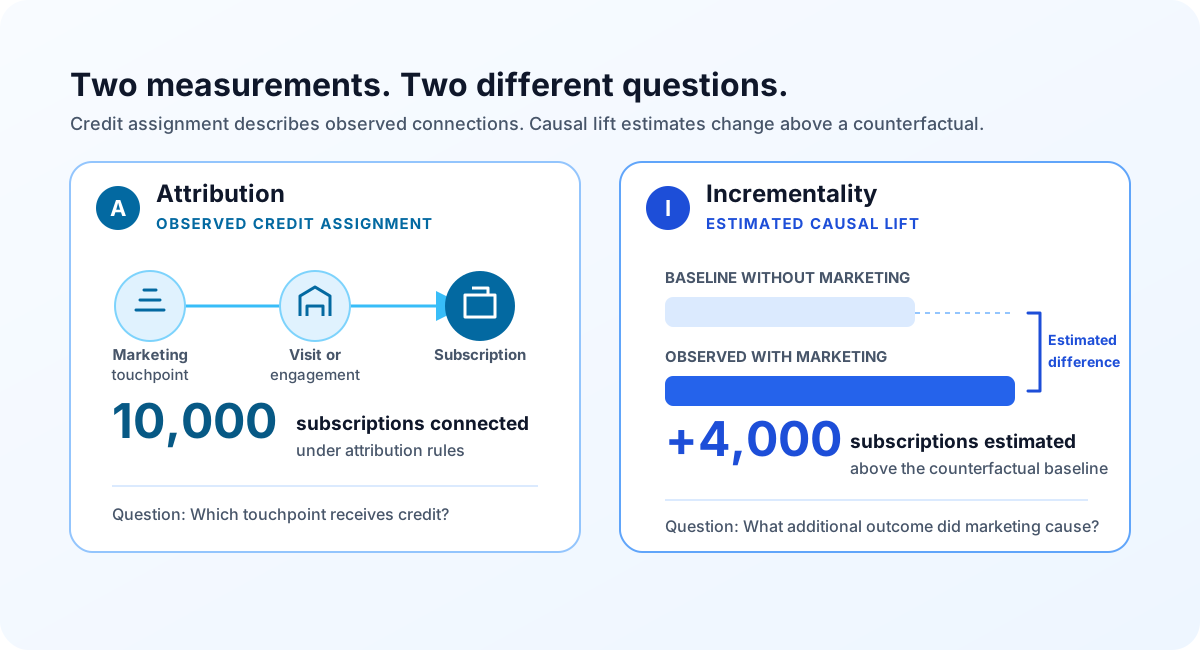
Consider a simplified example. An attribution system connects a streaming campaign to 10,000 subscriptions. A properly designed experiment estimates that the campaign produced 4,000 subscriptions above the counterfactual baseline.
Those are not contradictory results. The attribution system is describing observed connections under its attribution rules. The experiment is estimating the additional outcomes caused by the treatment.
Importantly, the experiment does not normally identify which specific 4,000 people were ‘caused’ by the campaign. Incrementality is estimated from the difference between what happened under treatment and what a credible counterfactual suggests would have happened without it.
| Question | Attribution | Incrementality |
|---|---|---|
| Primary question | Which touchpoint gets credit? | Did marketing cause additional outcomes? |
| Core concept | Credit assignment | Counterfactual causality |
| Typical output | Attributed conversions, CAC, ROAS, path analysis | Incremental conversions, lift, iCAC, iROAS |
| Operating cadence | Continuous / always on | Periodic tests or modeled estimates |
| Granularity | Often high | Usually lower |
| Best executive use | Operational optimization and journey visibility | Budget validation and causal decision-making |
Where attribution can mislead
Attribution is valuable, but it can over-credit channels that are good at finding people who were already likely to convert. Retargeting is a common example: the audience has already expressed intent, so a high attributed conversion rate does not prove the campaign created the conversion.
Last-touch models can also over-credit channels near the transaction and under-credit media that created demand earlier. View-through rules may assign credit to an impression even when the customer would have converted anyway. Shared households, missing app-store signals, inconsistent lookback windows, and overlapping platform claims can further change the attribution story.
Where incrementality can mislead or become impractical
Incrementality is not automatically correct simply because it uses causal language. Experiments need enough volume and statistical power. Holdouts can be relatively practical for retargeting when a company already has a clearly defined eligible audience that can be split into treatment and control groups. For broad prospecting or new-user acquisition, creating a credible unexposed control group can be more difficult and costly because media exposure is harder to isolate. Geo tests and matched-market designs can help, but they can be contaminated by national promotions, press, travel, content releases, or overlapping media. Results from one audience, budget level, or time period may not generalize forever.
Incrementality is also usually less granular and less real-time than attribution. A company cannot realistically run a clean causal test for every campaign, creative, audience, and placement every day.
The right lesson is not that one method is superior. It is that each method has a job, and each has limitations that executives should understand.
Three streaming examples
1. CTV campaign driving streaming subscriptions
A streaming service promotes a new bundle with CTV media. Its attribution rules connect 8,000 subscriptions to exposed households within a seven-day view-through window. Because creating a clean person-level holdout for broad prospecting can be difficult, the company uses a carefully designed geo test. The test estimates approximately 3,000 subscriptions above the expected baseline in treated markets.
The attribution result helps explain which conversions were connected to the campaign under the measurement rules. The incrementality result estimates the net-new impact. Both attributed CAC and incremental CAC matter, and the gap between them can materially change a scale decision.
2. Mobile engagement followed by a later CTV app open
A customer engages with a social ad on a phone, already has the mobile app, and later installs or opens the streaming app on Roku. Deterministic cross-device attribution can create a much stronger evidence chain than classifying the CTV open as organic.
That answers an attribution question: can the marketing interaction be connected to the later CTV behavior? Incrementality asks the next question: did that campaign create more CTV opens, viewing, or subscriptions than would have occurred without it?
3. Retargeting an existing streaming customer
A streaming service creates a retargeting campaign for subscribers who have not watched content recently. Attribution shows that many exposed customers returned and started watching again. Because these customers already have a relationship with the service, however, some may have returned even without the campaign.
In this case, the eligible retargeting audience can be divided into treatment and holdout groups more directly than a broad new-user acquisition audience. Attribution tells the team which returning activity is connected to the campaign. The holdout helps estimate how much additional re-engagement the campaign actually created.
How attribution and incrementality should work together
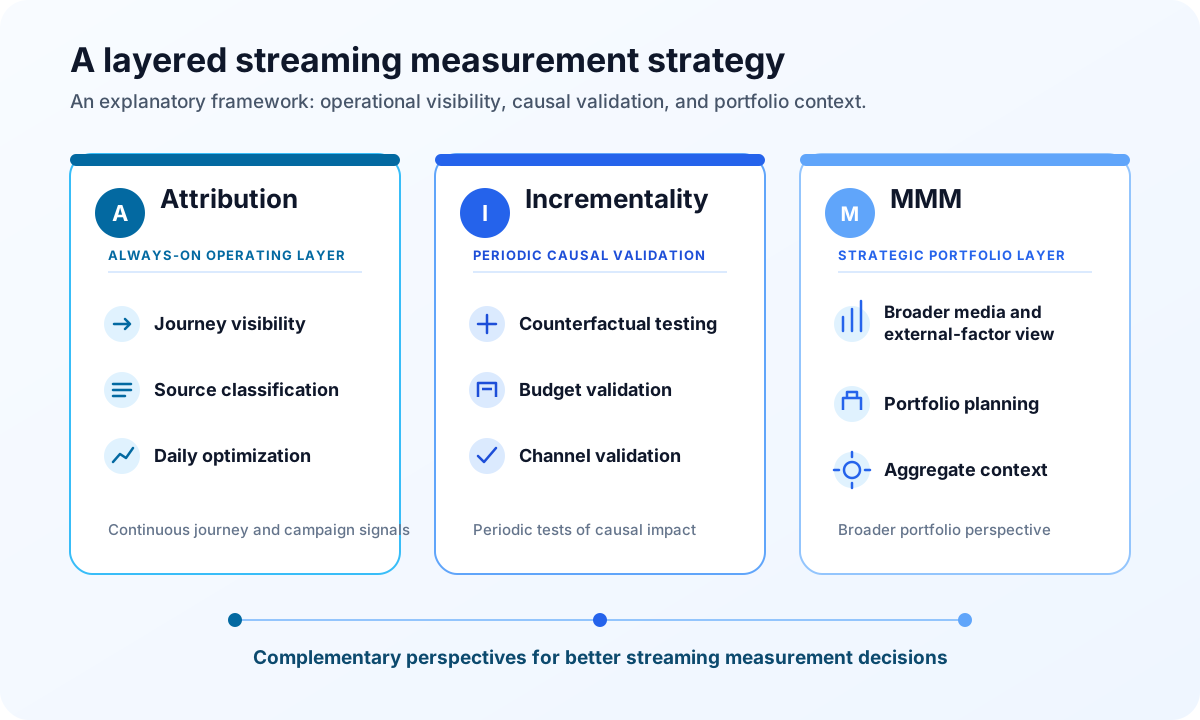
The strongest measurement system is layered rather than either/or.
- Use attribution as the always-on operating layer. It supports daily reporting, journey visibility, source classification, downstream-event analysis, and rapid optimization.
- Use incrementality for the decisions that matter most. Test major budget changes, new channels, retargeting strategies, branded search, or other areas where attribution may over-credit demand capture.
- Compare attributed and incremental results. Large gaps can reveal where a channel appears close to conversion but creates less net-new behavior than attribution suggests.
- Use experiments to calibrate interpretation. If attribution consistently differs from causal tests, teams can adjust how they interpret reports, bidding rules, or model weights.
- Re-test periodically. Incrementality is not a permanent property of a channel. It can change with budget, audience saturation, creative, competition, brand strength, and content demand.
A useful executive analogy is: attribution is the dashboard; incrementality is the audit. Marketing mix modeling can add a broader portfolio view across media and external factors. This is an explanatory framework, not a formal industry taxonomy, and MMM should not be expected to replace either of the first two layers.
What executives should ask
- When a report says “incremental,” “causal,” “lift,” or “net-new,” what is the counterfactual?
- Is the reported lift based on a true experiment or simply an exposed-versus-unexposed comparison?
- What are the attribution and conversion windows?
- How are outcomes deduplicated across platforms and self-attributing networks?
- What identity signals connect the journey, and where can those signals be lost?
- Was the experiment sufficiently powered, and what contamination or spillover could affect it?
- Are we evaluating downstream value such as viewing, subscriptions, purchases, revenue, or LTV rather than acquisition alone?
The executive takeaway
Streaming leaders do not need to choose between attribution and incrementality. They need to know which question they are asking.
Attribution provides the operating visibility required to understand journeys and optimize campaigns. Incrementality provides causal validation for the investment decisions where knowing what actually changed behavior matters most. Deterministic cross-device measurement can make the journey far more observable, but it should not be presented as proof of incremental lift.
A mature measurement strategy combines better observation with better causal validation. In streaming, where customer journeys cross screens, identities, app stores, and long conversion windows, that distinction is not academic. It is fundamental to making better growth decisions.
References
- Google Ads Help — Strengthen media measurement and ROI clarity with incrementality testing improvements (2025)
- IAB — Standardized Measurement Guide for CTV (2025)
- IAB — Guidelines for Incremental Measurement in Commerce Media (2025)
- IAB — Measurement Center
- Roku Advertising — From mobile ads to CTV: How your MMP works with Roku (2026)
- Roku Advertising — The Best Way to Measure TV Streaming Performance? Incrementality (2021)
- AppsFlyer Help Center — CTV, PC, and console platform attribution concepts (updated 2026)
- AppsFlyer — CTV Attribution
- Meta Business — Conversion Lift
- Gordon, Moakler & Zettelmeyer — Close Enough? A Large-Scale Exploration of Non-Experimental Approaches to Advertising Measurement
- Gordon et al. — Predicted Incrementality by Experimentation (PIE) for Ad Measurement (2026 version)
- Google Meridian — About MMM as a causal inference methodology
- Google Meridian GeoX
- Amazon Ads — Amazon DSP streaming TV campaigns and incremental QSR sales (2026)
- Netflix research — Estimating Incremental Acquisition of Content Launches in a Subscription Service (2021)
AI Transparency
CTVBridge uses AI tools to support research, content development, and editorial review. All articles are reviewed and approved by a human editor, and factual claims are supported by cited sources.