Marketing leaders often hear deterministic and probabilistic attribution described as competing attribution models. That framing creates confusion before the measurement conversation even begins.
The more useful question is not which method is better. It is: What can we prove, what can we reasonably infer, and what remains unknown?
Deterministic and probabilistic methods primarily describe the evidence used to connect events, devices, accounts, people, or households. They do not, by themselves, decide which marketing touchpoint gets credit, and neither proves that marketing caused an outcome.
Why This Matters
A customer journey can move from a social ad on a phone to a website visit, an app-store action, a CTV app install, a first app open, and eventually a subscription. The business wants to understand which marketing influenced that journey, but there may be no universal identifier connecting every step.
If a measurement system requires a verified identifier at every transition, real outcomes may remain unattributed. If it infers relationships too aggressively, it can over-credit marketing. The goal is not perfect visibility. It is to use evidence that is strong enough for the decision being made and to be clear about uncertainty.
First, Separate Three Different Measurement Questions
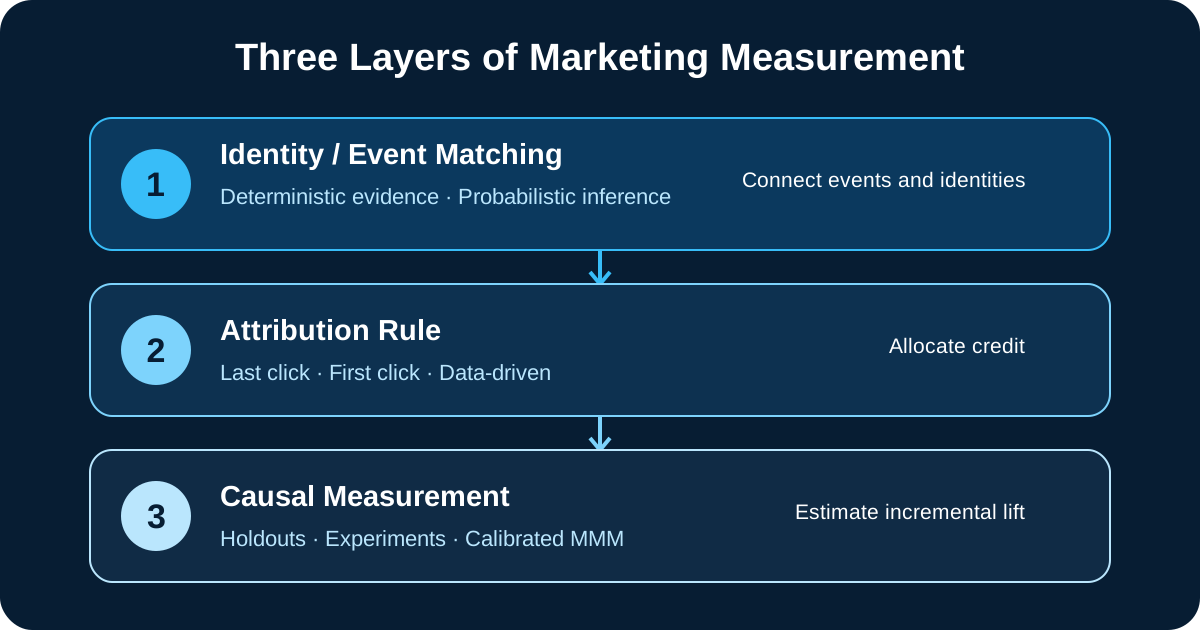
Many attribution debates become easier once three separate layers are kept apart:
| Layer | Question | Examples | Output |
|---|---|---|---|
| Identity / event matching | Do these events belong to the same person, device, household, account, or journey? | Login ID, device ID, signed platform signal, household inference | Verified or inferred relationship |
| Attribution rule | Which eligible marketing touchpoint receives credit? | Last click, first click, data-driven attribution | Credit allocation |
| Causal measurement | Did marketing cause incremental behavior? | Holdout, randomized experiment, geo test, calibrated MMM | Incremental lift / causal effect |
Deterministic and probabilistic methods mainly describe the first layer: how confidently events, devices, accounts, people, or households can be connected. Last-touch or data-driven attribution operates in the second layer. Incrementality belongs in the third. Throughout this article, deterministic matching or linkage refers to the evidence connection itself; it should not be read as proof that a specific marketing touchpoint caused or even directly drove a later CTV action.
This distinction matters because a deterministic match can still feed a weak attribution rule. Proving that a person clicked an ad and later subscribed does not prove the ad caused the subscription.
What Deterministic Matching Actually Means
Deterministic methods use directly observed or explicit evidence to connect relevant events. Depending on the environment, that evidence can include an authenticated first-party account, a permitted device identifier, a trusted install-referrer signal, a platform click identifier, or a signed platform attribution postback.
The advantage is confidence and auditability. When the linkage is valid, the business can make a stronger statement about what happened. The tradeoff is coverage: the necessary identifier or bridge does not exist for every journey.
A CTV Example
Imagine a subscriber receives an email on a phone and taps it. That action can be measured on the phone, and it may open the streaming service’s mobile app or website. Later, the subscriber independently opens the service on a television and signs in with the same first-party account. The account can deterministically show that the mobile and CTV activity belongs to the same authenticated customer, but it does not deterministically attribute the CTV app open to the earlier email. The email-to-CTV connection is a separate measurement problem.
This distinction is important. A deterministic customer identity can connect activity across authenticated environments without proving that one earlier marketing interaction drove the later CTV app open. If the customer also saw a paid social ad or visited the website, the business still needs an attribution method to decide what receives credit. And even a high-confidence attribution link would not, by itself, prove causality.
What Probabilistic Matching Actually Means
Probabilistic methods are used when a direct common identifier is missing. Instead of observing a verified bridge, a system estimates a likely relationship using permitted signals, statistical models, cohorts, aggregate behavior, or combinations of those inputs.
The benefit is broader coverage. The cost is uncertainty. False positives and false negatives are possible, and the quality of the result depends on the model, data, assumptions, thresholds, calibration, and how clearly confidence is communicated.
A Privacy-Era Example
Suppose a portion of customers cannot be directly connected from an advertising interaction to a later conversion because of consent choices, technical limitations, or cross-device gaps. A platform can use patterns from observable activity to estimate conversions in the unobservable portion. The result can improve aggregate reporting without identifying the individual users behind every estimated conversion.
That does not make the measurement useless or “guessing.” A well-calibrated model can be valuable for budget optimization when complete deterministic coverage is impossible. But the estimated outcomes should not be presented as if every conversion were individually verified.
Deterministic vs. Probabilistic: The Real Tradeoff
| Dimension | Deterministic | Probabilistic |
|---|---|---|
| Evidence | Direct or explicit linkage | Inferred from models, patterns, cohorts, or aggregate behavior |
| Primary strength | Precision / confidence | Coverage / reach |
| User-level proof | Potentially strong when the signal is valid | Usually weaker or unavailable |
| Coverage | Often incomplete | Often broader |
| Auditability | Usually easier to trace | Can be harder without model transparency |
| Best fit | Verification and decisions where a wrong match are costly | Optimization and measurement where signals are incomplete |
| Main failure mode | Missed or unattributed outcomes | Incorrect inference or overconfidence |
| Proves causality? | No | No |
A deterministic-only system can undercount or overrepresent easier-to-measure customers. A probabilistic system can increase coverage but create false confidence if uncertainty is hidden. Neither method wins universally.
Deterministic Does Not Mean Causal
This is one of the most important distinctions for executives. A direct match tells you that two events can be linked. It does not tell you what would have happened without the marketing exposure.
Consider a customer who clicks a retargeting ad minutes before subscribing. The click and subscription can be deterministically connected, and a last-click model may award the retargeting campaign all the credit. A later incrementality test could still show that most of those customers would have subscribed anyway. The match was correct. The causal conclusion was not.
That is why attribution and incrementality should be treated as complementary. Attribution helps reconstruct and assign credit within observed or inferred journeys. Incrementality asks what behavior marketing caused.
Privacy Is Changing the Measurement Stack
Privacy changes have reduced access to unrestricted user-level identifiers, but they have not created a simple shift from deterministic measurement to probabilistic measurement.
Apple’s App Tracking Transparency framework requires permission for certain forms of cross-app and cross-company tracking. At the same time, Apple’s AdAttributionKit can attribute app installations and re-engagements through signed, privacy-preserving postbacks without exposing a persistent cross-app identity. In other words, a platform can verify an attribution event while intentionally limiting user-level observability.
On Android, the Google Play Install Referrer API can securely return referral information and timestamps associated with an install. Google also uses modeled key events in Analytics when activity cannot be observed directly because of privacy, technical limitations, or cross-device gaps. On the web, Privacy Sandbox Attribution Reporting is designed to link ad interactions and conversions without cross-party user identifiers and can introduce delay, aggregation, and noise.
The direction of travel is therefore hybrid: first-party deterministic identity where it exists, platform-provided privacy-preserving signals, modeled measurement where direct observation is missing, and experiments or aggregate methods for causal questions.
Why CTV Makes the Distinction More Important
CTV intensifies the problem because marketing influence and streaming behavior often happen on different devices. A person may see an ad on a phone, visit a website, install a streaming app on a television, and open it hours or days later. The TV may also be shared by several people in a household.
That means a “matched CTV conversion” can represent very different evidence. It could be person-level, account-level, device-level, household-level, platform-postback-based, or modeled. Those categories should not be treated as interchangeable.
A household association can be useful for aggregate analysis, but it should not be presented as proof that the phone owner personally opened the TV app. Similarly, a CTV app install is not the same as verified use. When a business can create an explicit user-initiated bridge between the phone and television, evidence quality can improve because the system relies less on household inference.
Three Practical Customer Journeys
1. Authenticated Cross-Device Journey
A viewer taps an email on a phone, then later opens the streaming service on a CTV device and signs in to the same account. The shared first-party account can deterministically connect the authenticated customer across devices. It does not, however, prove that the email drove the CTV app open. Without a direct, supported bridge carrying campaign context into the CTV action, the email-to-CTV attribution remains unresolved even though the customer identity is known.
2. Web-to-CTV Journey Without a Direct Bridge
A viewer clicks a paid social ad, visits a streaming service website, and later opens the service on a Roku device in the same household. If the measurement system only knows that the phone and Roku repeatedly appear on the same household network, it may infer that the events belong to the same household. That relationship is probabilistic. It can support aggregate optimization, but it should not be described as person-level proof.
3. Verified Match, Wrong Business Conclusion
A viewer clicks a retargeting ad and subscribes shortly afterward. The click-to-subscription linkage is directly observed, so the match can be high confidence. If a last-click model gives the retargeting campaign 100% of the credit, however, the business may still overstate the campaign’s impact. A holdout test could show that many of those subscribers would have converted without the ad.
A Better Measurement Architecture: Use an Evidence Ladder
Instead of forcing every outcome into “attributed” or “unattributed,” mature measurement can expose the quality of the evidence behind each result:
- Verified first-party or platform evidence: authenticated IDs, direct user-initiated bridges, trusted referrer signals, or signed platform evidence.
- High-confidence deterministic identity: durable first-party or permitted device-level linkages with strong governance and deduplication.
- Probabilistic relationship: modeled person, device, or household associations above a documented confidence threshold.
- Aggregate modeled measurement: modeled conversions, privacy-preserving aggregate reporting, MMM, or other population-level estimates.
- Unknown / unattributed: insufficient evidence. Unknown should remain a valid answer rather than forcing a weak match.
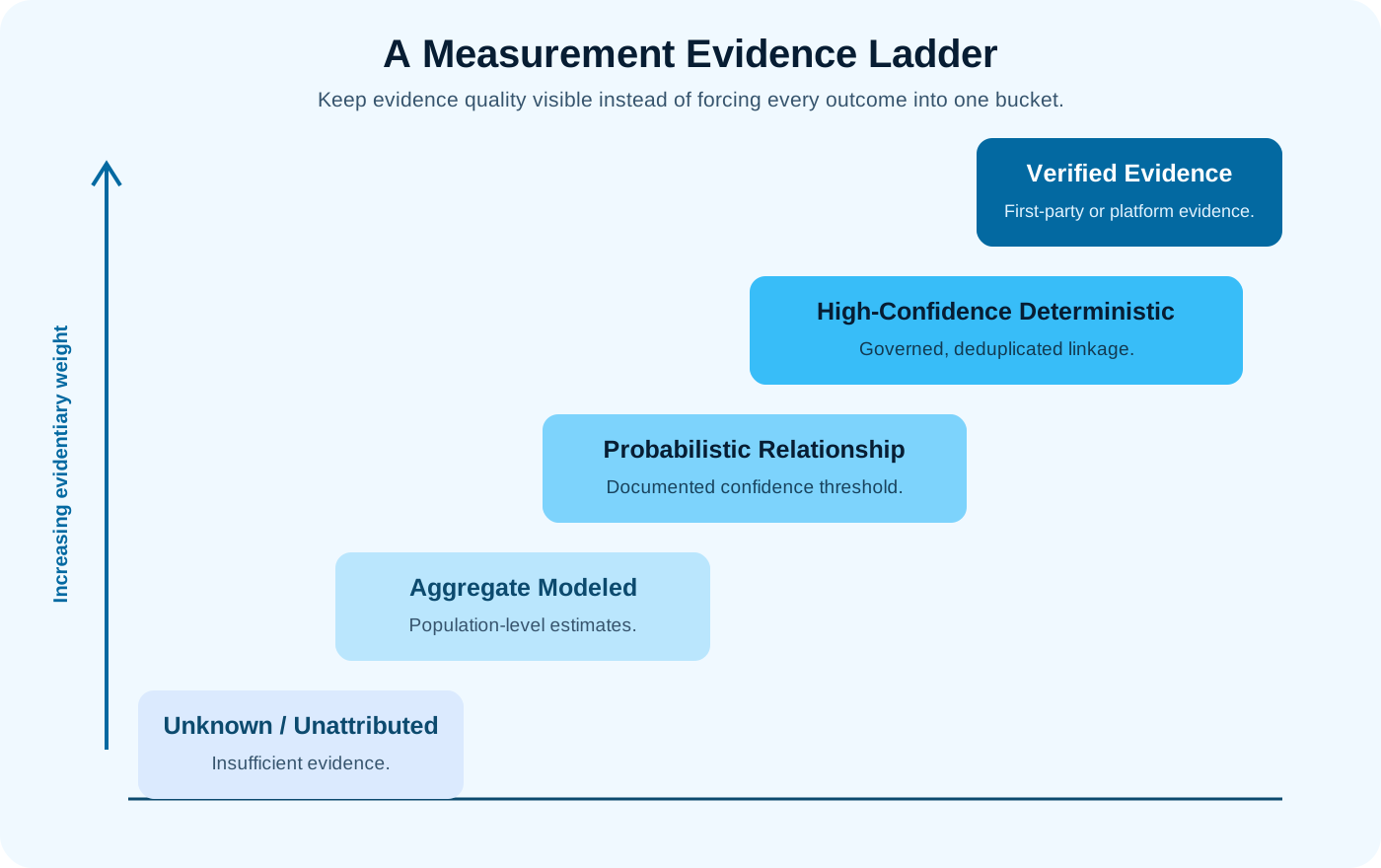
This structure makes an important business distinction visible: a modeled estimate and a verified user-level event can both be useful, but they should not appear to have the same evidentiary weight.
What Executives Should Ask
The practical goal is not to force a vendor or analytics team to choose one label. It is to understand what sits behind the number and whether that evidence is appropriate for the investment decision.
- What is being matched: a person, account, device, household, platform event, or modeled outcome?
- What percentage of reported outcomes are directly observed versus inferred or modeled?
- How is uncertainty represented? Can the system report unknown outcomes instead of forcing a match?
- How are competing claims deduplicated when multiple channels report the same conversion?
- Is the reported result descriptive attribution or evidence of incremental impact?
- Could deterministic-only reporting be biased toward logged-in, consented, or otherwise easier-to-measure customers?
The answers should influence how much confidence executives place in a KPI. User-level actions, billing decisions, suppression, or high-cost claims generally require stronger evidence than directional budget optimization. Aggregate planning can tolerate more inference when the model is validated and uncertainty is understood.
Key Takeaways
- Deterministic and probabilistic methods describe evidence and matching confidence; they are not the same thing as last-touch, first-touch, or data-driven attribution models.
- Deterministic methods can provide stronger linkage when valid evidence exists, but coverage is often incomplete.
- Probabilistic and modeled methods can recover useful measurement when direct observation is missing, but uncertainty must be visible.
- Neither deterministic nor probabilistic attribution proves causality. Incrementality addresses a different question.
- CTV makes evidence quality especially important because journeys cross devices and televisions are often shared.
- A mature measurement strategy combines methods and preserves “unknown” rather than pretending every outcome can be proven.
References
- Apple Developer — App Tracking Transparency.
- Apple Developer — Measuring ad performance with AdAttributionKit; AdAttributionKit framework and postback documentation.
- Android Developers — Google Play Install Referrer API.
- Google Privacy Sandbox — Attribution Reporting for Web and Android documentation.
- Google Analytics Help — About modeled key events; attribution documentation.
- LiveRamp Documentation — Deterministic Matching; Probabilistic Matching.
- Experian Marketing Services — Identity Resolution Guide.
- Runge, Skokan, Zhou & Pauwels — Packaging Up Media Mix Modeling: An Introduction to Robyn’s Open-Source Approach (arXiv, 2024).
AI Transparency
CTVBridge uses AI tools to support research, content development, and editorial review. All articles are reviewed and approved by a human editor, and factual claims are supported by cited sources.