A customer sees a creator recommend a new series on a phone during lunch. The recommendation creates interest, but there is no immediate subscription or stream. That evening, the customer opens the streaming service on a connected TV and starts watching. To the customer, this is one simple journey. To the company’s measurement systems, it can look like two unrelated events.
That gap matters. When marketing activity happens on one screen and the meaningful outcome happens on another, teams can undervalue the touchpoint that created demand, overvalue the endpoint device, or classify a later CTV session as direct or organic because the earlier signal was lost.
The challenge is not that every streaming journey crosses devices. Many do not. The challenge is that streaming services operate across an ecosystem of phones, browsers, televisions, app stores, CRM channels, and platform accounts. Measurement strategies that assume the journey starts and ends on one device can stop before the customer journey does.
The customer journey is a sequence of jobs, not devices
Customers choose different screens for different jobs. Phones are efficient for discovery, search, messaging, and notifications. Browsers can make evaluation and plan comparison easier. Televisions are designed for lean-back, shared, long-form viewing. The device may change because the customer is simply moving to the interface that best fits the next task.
That is why cross-device streaming measurement should focus on continuity over time, not only simultaneous “second-screen” behavior. One device can create intent, another can handle account activity, and a television can deliver the viewing outcome hours or days later.
| Journey job | Common surface | Useful measurement event |
|---|---|---|
| Discovery | Social, search, creator video, web, TV promo | Impression, view, referral, search |
| Evaluation | Phone or web | Landing-page visit, app-store view, plan view |
| Acquisition / access | Phone, web, or TV platform | Install, signup, entitlement, login |
| Consumption | CTV, smart TV, mobile, tablet, web | App open, stream start, watch time |
| Re-engagement | Push, email, paid media, in-app | Delivery, open, exposure, return session |
Discovery and viewing often live on different surfaces
Independent research supports the broader behavior behind this problem without proving a universal mobile-to-CTV path. Deloitte’s 2025 Digital Media Trends research found that social platforms and online creators play an important role in entertainment discovery, particularly for younger consumers. Deloitte reported that 56% of younger generations surveyed said they watch TV shows or movies on subscription streaming services after hearing about them from creators online, while 53% said social media gives them better recommendations than streaming services.
At the same time, television remains important for premium long-form viewing. Nielsen’s August 2025 All Screens Video Landscape reported that 83% of Netflix viewing in the measured market occurred on the television screen. That figure should not be treated as a U.S. share, but it supports the broader point that discovery and consumption do not need to happen on the same screen.
The evidence does not tell us how often one specific U.S. consumer discovers content on mobile and later watches it on CTV. It does show why streaming leaders should not assume that the screen where interest begins will always be the screen where the meaningful outcome occurs.
The customer journey continues while measurement continuity breaks
The business problem appears when each system sees only its own part of the journey. A social platform may record an impression or engagement. A CRM platform may record an email delivery or push notification. An app store may record an install. A CTV app may record an app open or viewing session. Each record can be correct while the organization still fails to understand that the events may belong to one continuing customer relationship.
Industry standards reflect this complexity. IAB guidance describes fragmented CTV standards, inconsistent signals, different identifiers, and siloed measurement across CTV, online video, social video, and FAST environments. Media Rating Council standards likewise emphasize deduplicated cross-media measurement, privacy, disclosure, and the need to distinguish individual from household measurement.
When the connection disappears at a device boundary, a real marketing contribution can become invisible. A later CTV app open may appear organic, a re-engagement campaign may look ineffective because there was no click, or acquisition and viewing may be optimized as separate funnels even though the customer experiences one service.
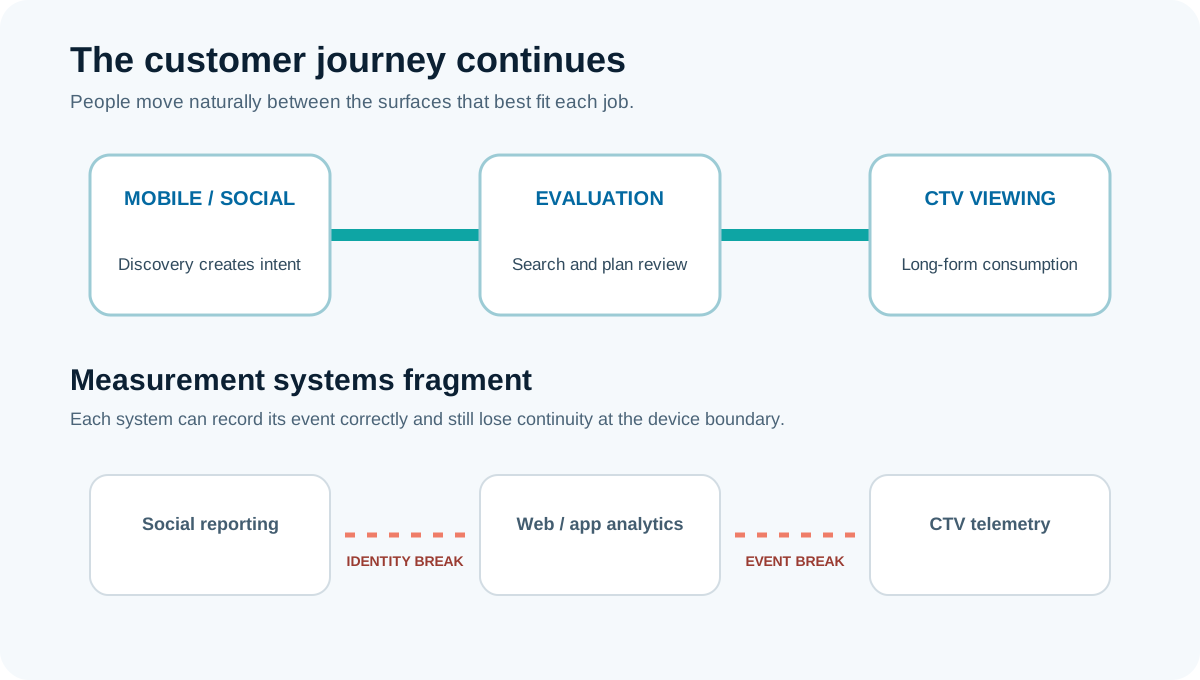
Where continuity is usually lost
- Identifiers change across mobile apps, browsers, smart TVs, streaming devices, app stores, and publisher account systems.
- Platform reporting is siloed. Social, CRM, app-store, TV-platform, analytics, and MMP systems may each see only part of the journey.
- Time creates distance between intent and outcome. A recommendation in the morning can become a TV viewing session that night.
- Shared television screens create identity ambiguity. A phone may be associated with one person while a CTV session represents a household or multiple viewers.
- Privacy and consent appropriately limit what should be connected. The goal is not to track everything, but to use the minimum identity needed to answer the business question.
Measure with the right level of confidence
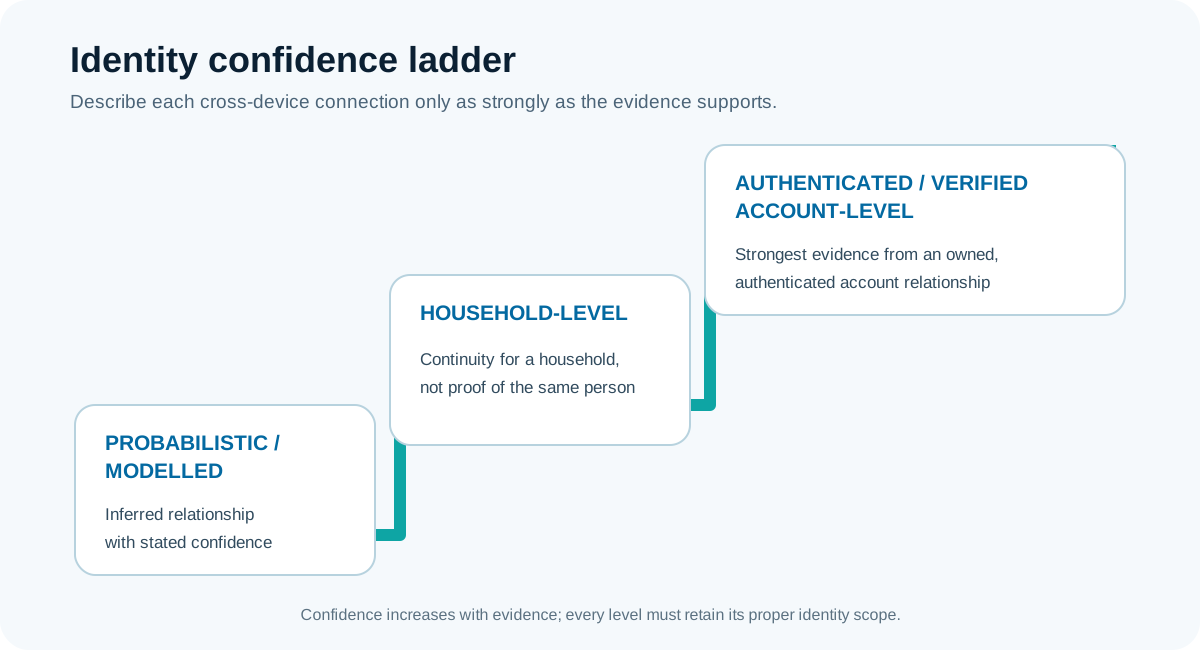
Cross-device connections can have different levels of confidence. Authenticated first-party connections are generally stronger than household-level or probabilistic/modelled relationships, and teams should describe each connection only as strongly as the evidence supports. For a deeper explanation of these identity concepts, see First-Party Identity in Cross-Device Streaming Measurement.
Three examples of the measurement problem
1. Paid social discovery to CTV viewing
A consumer sees a paid social ad for a new drama on a phone, later searches for it, and opens the streaming service on a smart TV after dinner. There may be no direct click from the social platform to the TV app. Device-level analytics can therefore classify the TV session as organic even though the earlier paid social touchpoint may have influenced the journey.
2. Email or push re-engagement to television
A registered user receives a push notification or email about a new episode. The message creates intent, but the user does not click. Later, the user opens the service on the living-room TV. Click-only reporting can miss the relationship between the CRM touchpoint and the return session.
3. Shared-household ambiguity
One person in a household sees a mobile promotion for a new series. Later, another household member opens the service on the shared television and the family watches together. A household connection may be valid, but it would be incorrect to claim that the mobile viewer personally completed the downstream CTV action.
Be clear about what attribution tells you
Connecting an earlier marketing touchpoint to a later CTV outcome improves visibility into the customer journey and gives teams a clearer way to assign attribution. That connection is valuable on its own, as long as teams are clear about what their attribution model is designed to measure.
Attribution helps answer which observed touchpoints are connected to a downstream outcome and which touchpoint receives credit under the chosen model. It should not be presented as proof that marketing caused the outcome. When a team specifically needs to measure causal lift, incrementality methods can answer that separate question.
An executive framework for cross-device streaming measurement
Before investing in more identity or measurement infrastructure, leaders can start with five questions:
- What outcome are we actually trying to measure: verified CTV viewing or activation, watch time, subscription, retention, or another business result?
- At what identity level can we defend the connection: authenticated individual/account, household, or modelled relationship?
- Where does identity or event continuity disappear between the marketing touchpoint and the downstream outcome?
- Which links in the journey are verified and which are inferred?
- Are we clear about what our attribution model can tell us, and where its limits begin?
Verified CTV viewing is often a clear downstream example because it confirms that the customer reached and used the television experience. The same framework can extend to watch time, subscription, retention, and other meaningful outcomes when the underlying identity and event data support the connection.
Measure the customer relationship, not only the endpoint device
Streaming services are customer relationships expressed through many screens. A phone can create intent. A browser can support evaluation. A television can deliver the viewing experience. A CRM message can bring the customer back days later.
The goal is not to force every event into a perfect person-level graph. It is to preserve enough continuity to make defensible growth decisions, while being clear about where the evidence is authenticated, household-level, or modelled.
The customer journey can continue smoothly even when the measurement journey breaks. Organizations that recognize that difference are better positioned to understand how marketing contributes to acquisition, re-engagement, and downstream streaming value.
References
- Deloitte — 2025 Digital Media Trends
- Deloitte — From Subscribers to Superfans (2026)
- Nielsen/Gracenote — 2025 State of Play findings
- Nielsen — All Screens Video Landscape, August 2025
- IAB — Standardized Measurement Guide for CTV (2025)
- IAB — Unified Media Planning Playbook (2025)
- IAB — Anatomy of a Video Impression / CTV
- IAB Tech Lab — Project Crosswalk 2.0
- Media Rating Council — Cross-Media Audience Measurement Standards
- Media Rating Council — Outcomes and Data Quality Standards
- Roku Developer — Authentication / Automatic Account Link
- Amazon Developer — Simple Sign-in
AI Transparency
CTVBridge uses AI tools to support research, content development, and editorial review. All articles are reviewed and approved by a human editor, and factual claims are supported by cited sources.